People's Republic of Bangladesh
- গণপ্রজাতন্ত্রী বাংলাদেশ
- Gônôprôjatôntri Bangladesh
|
|
|
Anthem: "Amar Sonar Bangla"
"My Golden Bengal"
|
|
|
|
Capital
and largest city |
Dhaka
 23°42′N 90°21′E 23°42′N 90°21′E |
| Official languages |
Bengali |
| Recognized |
English |
| Ethnic groups (2011) |
98% Bengalis
2% Others[2] |
| Religion |
89.1% Islam
10% Hinduism
0.9% Others[2] |
| Demonym |
Bangladeshi |
| Government |
Unitary parliamentary constitutional republic |
| • |
President |
Abdul Hamid |
| • |
Prime Minister |
Sheikh Hasina |
| • |
Speaker of Parliament |
Shirin Sharmin Chaudhury |
| • |
Chief Justice |
Surendra Kumar Sinha |
| Legislature |
Jatiyo Sangshad |
|
|
| • |
Independence declared from Pakistan |
March 26, 1971 |
| • |
Government |
April 17, 1971 |
| • |
Liberation |
December 16, 1971 |
| • |
Current constitution |
November 4, 1972 |
| • |
Last territorial admission |
July 31, 2015 |
| Area |
| • |
Total |
147,570[3] km2 (92nd)
56,977 sq mi |
| • |
Water (%) |
6.4 |
| Population |
| • |
2015 estimate |
168,957,745[2] (8th) |
| • |
2011 census |
149,772,364[4] (8th) |
| • |
Density |
1,319/km2 (10th)
3,416/sq mi |
| GDP (PPP) |
2015 estimate |
| • |
Total |
$572.440 billion[5] (34th) |
| • |
Per capita |
$3,581[5] (144th) |
| GDP (nominal) |
2015 estimate |
| • |
Total |
$205.327 billion[5] (44th) |
| • |
Per capita |
$1,284[5] (155th) |
| Gini (2010) |
32.1[6]
medium |
| HDI (2015) |
 0.570[7] 0.570[7]
medium · 142nd |
| Currency |
Taka (৳) (BDT) |
| Time zone |
BST (UTC+6) |
| Date format |
- dd-mm-yyyy
- BS দদ-মম-বববব (CE−594)
|
| Drives on the |
left |
| Calling code |
+880 |
| ISO 3166 code |
BD |
| Internet TLD |
.bd
.বাংলা |
Bangladesh (
 i
i;
;
বাংলাদেশ,
pronounced: [ˈbaŋlad̪eʃ] ( listen)
,
lit. "The country of Bengal"), officially the
People's Republic of Bangladesh (গণপ্রজাতন্ত্রী বাংলাদেশ
Gônôprôjatôntri Bangladesh), is a sovereign country in
South Asia. It forms the largest and eastern portion the ethno-linguistic region of
Bengal. Located at the apex of the
Bay of Bengal, the country is bordered by
India and
Myanmar and is separated from
Nepal and
Bhutan by the narrow
Siliguri Corridor.
[8] With a population of
170 million, it is the world's
eighth-most populous country, the
fifth-most populous in Asia and the third-most populous
Muslim-majority country. The official
Bengali language is the
seventh-most spoken language in the world, which Bangladesh shares with the neighboring Indian states of
West Bengal,
Tripura and
Assam (
Barak Valley).
Three of Asia's largest rivers, the
Ganges (locally known as the
Padma), the
Brahmaputra (locally known as the
Jamuna) and the
Meghna, flow through Bangladesh and form the fertile
Bengal delta—the largest delta in the world.
[9] With rich
biodiversity, Bangladesh is home to
700 rivers, most of the
world's largest mangrove forest; rainforested and tea-growing
highlands; a 600 km (370 mi) coastline with the world's longest
beach; and various
islands, including a
coral reef. Bangladesh is one of the
most densely populated countries in the world, ranking alongside South Korea and Monaco. The capital
Dhaka and the port city of
Chittagong are the most prominent urban centers. The predominant ethnic group are
Bengalis, with a politically-dominant
Bengali Muslim majority, followed by
Bengali Hindus,
Chakmas,
Bengali Christians,
Marmas,
Tanchangyas,
Bisnupriya Manipuris,
Bengali Buddhists,
Garos,
Santhals,
Biharis,
Oraons,
Tripuris,
Mundas,
Rakhines,
Rohingyas,
Ismailis and
Bahais.
[10]
Greater Bengal was known to the ancient
Greeks and
Romans as
Gangaridai.
[11] The people of the delta developed their own language,
script,
literature,
music, art and
architecture. Early Asian literature described the region as a
seafaring power.
[12] It was an important
entrepot of the historic
Silk Road.
[13] Bengal was absorbed into the
Muslim world and ruled by
sultans for four centuries, including under the
Delhi Sultanate and the
Bengal Sultanate. This was followed by the
administration of the
Mughal Empire. Islamic Bengal was a
melting pot, a regional power and a key player in medieval world trade.
British colonial conquest took place in the late-18th century.
Nationalism, social reforms and the arts developed under the
British Raj in the late 19th and early 20th centuries, when the region was a hotbed of the
anti-colonial movement in the
subcontinent.
The
first British partition of Bengal in 1905, that created the province of
Eastern Bengal and Assam, set the precedent for the
Partition of British India in 1947, when
East Bengal joined the
Dominion of Pakistan and was renamed as
East Pakistan in 1955. It was separated from
West Pakistan
by 1,400 kilometres (870 mi) of Indian territory. East Pakistan was
home to the country's demographic majority and its legislative capital.
[14][15] The
Bangladesh Liberation War in 1971 resulted in the secession of East Pakistan as a new republic with a
secular multiparty parliamentary democracy.
[16][17][18] A short-lived
one party state and several
military coups in 1975 established a
presidential government.
The restoration of the parliamentary republic in 1991 led to improved
economic growth and relative stability. Bangladesh continues to face
challenges of poverty, corruption, polarized politics, human rights
abuses by security forces, overpopulation and global warming. However,
the country has achieved notable
human development progress, including in health, education, gender equality, population control and food production.
[19][20][21] The poverty rate has reduced from 57% in 1990 to 25.6% in 2014.
[22]
Considered a
middle power in international affairs and a major
developing country, Bangladesh is listed as one of the
Next Eleven. It is a
unitary state with an elected parliament called the
Jatiyo Sangshad. Bangladesh has the third-largest
economy and
military in South Asia after India and Pakistan. It is a founding member of
SAARC and hosts the permanent secretariat of
BIMSTEC.
[23] The country is the world's
largest contributor to
United Nations peacekeeping operations.
[24] It is a member of the
Developing 8 Countries, the
OIC, the
Commonwealth of Nations, the
World Trade Organization, the
Group of 77, the
Non-Aligned Movement,
BCIM and the
Indian Ocean Rim Association. The country has significant natural resources, including
natural gas and limestone.
Agriculture mainly produces rice,
jute and tea. Historically renowned for
muslin and
silk, modern Bangladesh is one of the world's leading
textile
producers. Its major trading partners include the European Union, the
United States, Japan and the other nearby nations of China, Singapore,
Malaysia and India.
Etymology
The name
Bangladesh was originally written as two words,
Bangla Desh. Starting in the 1950s, Bengali nationalists used the term in political rallies in
East Pakistan. The term
Bangla is a major name for both the
Bengal region and the
Bengali language.
The earliest references to the term date to the Nesari plate in 805 AD.
The term "Vangaladesa" is found in South Indian records in the 11th
century.
[25][26][27]
The term gained official status during the
Sultanate of Bengal in the 14th century.
[28][29] Shamsuddin Ilyas Shah proclaimed himself as the first "
Shah of Bangala" in 1342.
[28] The word
Bangla became the most common name for the region during the Islamic period. The Portuguese referred to the region as
Bengala in the 16th century.
[30]
The origins of the term
Bangla are unclear, with theories pointing to a
Bronze Age proto-Dravidian tribe,
[31] the
Austric word "Bonga" (Sun god),
[32] and the Iron Age
Vanga Kingdom.
[32] The Indo-Aryan suffix
Desh is derived from the Sanskrit word
deśha, which means "land" or "country". Hence, the name
Bangladesh means "Land of Bengal" or "Country of Bengal".
[25][26][27]
History
Ancient and classical Bengal
Stone age tools found in the Greater Bengal region indicate human habitation for over 20,000 years.
[33] Remnants of
Copper Age settlements date back 4,000 years.
[33]
Ancient Bengal was settled by
Austroasiatics,
Tibeto-Burmans,
Dravidians and
Indo-Aryans in consecutive waves of migration.
[34][35] Major urban settlements formed during the
Iron Age in the middle of the
first millennium BCE,
[36] when the
Northern Black Polished Ware culture developed in the
Indian subcontinent.
[37] In 1879,
Sir Alexander Cunningham identified the archaeological ruins of
Mahasthangarh as the ancient city of Pundranagara, the capital of the
Pundra Kingdom mentioned in the
Rigveda.
[38][39]
The
Wari-Bateshwar ruins are regarded by archaeologists as the capital of an ancient
janapada, one of the earliest city states in the subcontinent.
[40] An indigenous
currency of silver punched marked coins dating between 600 BCE and 400 BCE has been found at the site.
[40] Excavations of glass beads suggest the city had trading links with
Southeast Asia and the
Roman world.
[41]
Greek and Roman records of the ancient
Gangaridai Kingdom, which according to legend deterred the invasion of
Alexander the Great, are linked to the fort city in Wari-Bateshwar.
[40] The site is also identified with the prosperous trading center of
Souanagoura mentioned in
Ptolemy's world map.
[41] Roman geographers noted the existence of a large and important
seaport in southeastern Bengal, corresponding to the modern-day
Chittagong region.
[42]
The legendary
Vanga Kingdom is mentioned in the Indian epic
Mahabharata covering the region of Bangladesh. It was described as a
seafaring nation of South Asia. According to
Sinhalese chronicles, the Bengali
Prince Vijaya led a maritime expedition to
Sri Lanka, conquering the island and establishing its first recorded kingdom.
[43] The Bengali people also embarked on overseas colonization in Southeast Asia, including in modern-day
Malaysia and
Indonesia.
[44]
Bengal was ruled by the
Mauryan Empire in the 3rd and 2nd centuries BCE. With their bastions in the Bengal and
Bihar regions (collectively known as
Magadha), the Mauryans built the first
geographically extensive Iron Age empire in
Ancient India. They promoted
Jainism and
Buddhism. The empire reached its peak under emperor
Ashoka. They were eventually succeeded by the
Gupta Empire in the 3rd century. According to historian
H. C. Roychowdhury, the Gupta dynasty
originated in the
Varendra region in Bangladesh, corresponding to the modern-day
Rajshahi and
Rangpur divisions.
[45] The Gupta era saw the invention of
chess, the concept of
zero, the
theory of Earth orbiting the Sun, the study of
solar and
lunar eclipses and the flourishing of
Sanskrit literature and
drama.
[46][47]
In
classical antiquity, Bengal was divided between various kingdoms. The
Pala Empire stood out as the largest Bengali state established in ancient history, with an
empire covering most of the north Indian subcontinent at its height in the 9th century. The Palas were devout
Mahayana Buddhists. They strongly patronized art, architecture and education, giving rise to the Pala School of Painting and Sculptural Art,
[48] the
Somapura Mahavihara and the universities of
Nalanda and
Vikramshila. The proto-
Bengali language emerged under Pala rule. In the 11th-century, the resurgent
Hindu Sena dynasty gained power. The Senas were staunch promoters of
Brahmanical Hinduism and laid the foundation of Bengali Hinduism. They patronized their own school of
Hindu art taking inspiration from their predecessors.
[49] The Senas consolidated the
caste system in Bengal.
[50]
Bengal was also a junction of the Southwestern
Silk Road.
[13]
Islamic Bengal
Islam arrived on the shores of Bengal in the late first millennium, brought largely by missionaries,
Sufis and merchants from the
Middle East. Some experts have suggested that early Muslims, including
Sa`d ibn Abi Waqqas (an uncle of the
Prophet Muhammad), used Bengal as a transit point to travel to
China on the Southern
Silk Road.
[52] The excavation of
Abbasid Caliphate coins in Bangladesh indicate a strong trade network during the
House of Wisdom Era in
Baghdad, when Arab scientists absorbed pre-Islamic Indian and
Greek discoveries.
[53] This gave rise to the system of Indo-Arabic numerals. Writing in 1154,
Al-Idrisi noted a busy shipping route between Chittagong and
Basra.
[54]
Subsequent Muslim conquest absorbed the culture and achievements of pre-Islamic Bengali civilization in the new Islamic
polity.
[55] Muslims adopted indigenous customs and traditions, including dress, food, and way of life. This included the wearing of the
sari,
bindu, and
bangles by Muslim women; and art forms in
music,
dance, and theater.
[55] Muslim rule reinforced the process of conversion through the construction of
mosques,
madrasas and
Sufi Khanqahs.
[56]
The Islamic conquest of Bengal began when
Bakhtiar Khilji of the
Delhi Sultanate conquered northern and western Bengal in 1204.
[57] The Delhi Sultanate gradually annexed the whole of Bengal over the next century. By the 14th century, an independent
Bengal Sultanate was established.
[58] The rulers of the
Turkic[59][60][61] Ilyas Shahi dynasty built the
largest mosque in South Asia, and cultivated strong diplomatic and commercial ties with
Ming China.
[62][63]
Jalaluddin Muhammad Shah was the first Bengali convert on the throne.
[58] The Bengal Sultanate was noted for its
cultural pluralism.
Muslims,
Hindus and
Buddhists jointly formed its civil-military services. The
Hussain Shahi sultans promoted the development of
Bengali literature.
[64] It brought
Arakan under its
suzerainty for 100 years.
[65]
The sultanate was visited by numerous world
explorers, including
Niccolò de' Conti of
Venice,
Ibn Battuta of
Morocco and
Admiral Zheng He of
China. However, by the 16th century, the Bengal Sultanate began to disintegrate. The
Sur Empire overran Bengal in 1532 and built the
Grand Trunk Road.
Hindu Rajas and the
Baro-Bhuyan zamindars gained control of large parts of the region, especially in the fertile
Bhati zone.
Isa Khan was the
Rajput leader of the Baro-Bhuyans based in
Sonargaon.
[66]
In the late 16th-century, the
Mughal Empire led by
Akbar the Great began conquering the Bengal delta after the
Battle of Tukaroi,
[67] where he defeated the Bengal Sultanate's last rulers, the
Karrani dynasty.
Dhaka was established as the Mughal provincial capital in 1608. The
Mughals faced stiff resistance from the Baro-Bhuyans, Afghan warlords
and zamindars, but were ultimately successful in conquering the whole of
Bengal by 1666, when the
Portuguese
and Arakanese were expelled from Chittagong. Mughal rule ushered
economic prosperity, agrarian reform and flourishing external trade,
particularly in
muslin and
silk
textiles. Mughal Viceroys promoted agricultural expansion and turned
Bengal into the rice basket of the Indian subcontinent. The
Sufis gained increasing prominence. The
Baul
movement, inspired by Sufism, also emerged under Mughal rule. The
Bengali ethnic identity further crystallized during this period, and the
region's inhabitants were given sufficient autonomy to cultivate their
own customs and literature. The entire region was brought under a
stable-long lasting administration.
[62]
By the 18th century, the
Bengal Subah included the dominions of Bengal proper,
Bihar and
Orissa. It was the wealthiest part of the subcontinent.
[68] It generated 50% of Mughal GDP.
[69] Its towns and cities were filled with Eurasian traders.
Dhaka became an important center of Mughal administration. The
Nawabs of Bengal established an independent
principality in 1717, with their headquarters in
Murshidabad. The Nawabs granted increasing concessions to European trading powers. Matters reached a climax in 1757, when Nawab
Siraj-ud-Daulah captured the British base at
Fort William, in an effort to stem the rising influence of the
East India Company. Siraj-ud-Daulah was betrayed by his general
Mir Jafar, who helped
Robert Clive defeat the last independent Nawab at the
Battle of Plassey on 23 June 1757.
[70][71]
British Bengal
The first
steam engine in Eastern Bengal. Railways in Bangladesh date back to 1862, being one of the earliest rail networks in the world
The defeat of the last independent Nawab of Bengal at the
Battle of Plassey ushered the
rule of the British East India Company in 1757. The British displaced the ruling Muslim class of Bengal.
[72] The
Bengal Presidency was established in 1765, with
Calcutta as its capital. The
Permanent Settlement created an oppressive feudal system. A number of deadly famines struck the region.
The
Mutiny of 1857 was initiated in the Presidency of Bengal, with major revolts by the
Bengal Army in
Dacca, Calcutta and
Chittagong.
[73][74] Eastern Bengal witnessed numerous native rebellions, including the
Faraizi Movement by
Haji Shariatullah, the activities of
Titumir, the
Chittagong armoury raid and revolutionary formations such as the
Anushilan Samiti. The
Bengal Renaissance
flowered as a result of educational and cultural institutions being
established across the region, especially in East Bengal and the
imperial colonial capital Calcutta. The Presidency of Bengal became the
cradle of modern South Asian political and artistic expression. It
included the notable contributions of
Raja Ram Mohan Roy,
Mir Mosharraf Hossain,
Ishwar Chandra Vidyasagar,
Sir Syed Ahmed Khan,
Jagadish Chandra Bose,
Khan Bahadur Ahsanullah,
Rabindranath Tagore,
Michael Madhusudan Dutt,
Kazi Nazrul Islam and
Begum Rokeya.
Gopal Krishna Gokhle, the mentor of
Mahatma Gandhi, remarked that "what Bengal thinks today, India thinks tomorrow".
[75]
During British rule, East Bengal developed a
plantation economy centred on the
jute trade and
tea production. Its share in world jute supply peaked in the early 20th century, at over 80%.
[76] The
Eastern Bengal Railway and the
Assam Bengal Railway served as important trade routes, connecting the
Port of Chittagong with a large hinterland.
As a result of growing demands for educational development in East Bengal, the British
partitioned Bengal in 1905 and created the administrative division of
Eastern Bengal and Assam. Based in
Dacca, with
Shillong as the summer capital and
Chittagong as the chief port, the new province covered much of the northeastern subcontinent. The
All India Muslim League
was formed in Dacca in 1906 and emerged as the standard bearer of
Muslims in British India. The partition of Bengal outraged nationalist
Hindus and anti-British Muslims, leading to the
Swadeshi movement by the
Indian National Congress. The partition was annulled in 1911 after a long civil disobedience campaign by the Congress. The
Indian Independence Movement enjoyed strong momentum in the Bengal region, including the
constitutional struggle for the rights of Muslim minorities.
The
Freedom of Intellect Movement thrived in the
University of Dacca. By the 1930s, the
Krishak Praja Party led by
A. K. Fazlul Huq and the
Swaraj Party led by
C. R. Das came to represent the new Bengali
middle class. Huq became the
Prime Minister of Bengal in 1937. With the breakdown of
Hindu-
Muslim unity in the British Raj, Huq allied with the Muslim League to present the
Lahore Resolution in 1940, which envisioned independent states in the eastern and northwestern subcontinent.
During the
Second World War, the
Japanese Air Force conducted air raids in Chittagong in 1942, displacing several thousand people.
[77][78] The war-induced
Bengal famine of 1943 claimed the lives of over a million people.
Allied forces were stationed in bases across East Bengal in support of the
Burma Campaign.
Axis-allied
Subhash Chandra Bose also had a significant following in East Bengal.
The
Muslim League formed a parliamentary government in Bengal in 1943, with Sir
Khawaja Nazimuddin and later
H. S. Suhrawardy as its premiers. At the
Indian provincial elections, 1946, the decisive victory of the Bengal Muslim League set the course for the
Partition of British India and the creation of the
Dominion of Pakistan on 14 August 1947.
Assam was partitioned in order to allow Bengali-speaking
Sylhet to join
East Bengal. There was also an unsuccessful attempt to form a
United Bengal. The
Radcliffe Line
divided Bengal on religious grounds, ceding Hindu-majority districts to
the Indian dominion, and making Muslim-majority districts the eastern
wing of Pakistan.
Eastern wing of Pakistan
East Bengal was the most populous province in the new
Pakistani federation led by
Governor General Muhammad Ali Jinnah in 1947, with
Dacca as the provincial capital.
[79] While the
state of Pakistan was created as a homeland for
Muslims of the former
British Raj,
East Bengal was also Pakistan's most cosmopolitan province, being home
to peoples of different faiths, cultures and ethnic groups. In 1950,
land reform was accomplished in East Bengal with the abolishment of the
permanent settlement and the feudal
zamindari system.
[80]
The successful
Bengali Language Movement in 1952 was the first sign of friction with
West Pakistan.
[81] The
One Unit scheme renamed the province as
East Pakistan in 1955. The
Awami League emerged as the political voice of the Bengali-speaking population,
[82] with its leader
H. S. Suhrawardy becoming
Prime Minister of Pakistan in 1956. He was ousted after only a year in office due to tensions with West Pakistan's establishment and bureaucracy.
[83]
The
1956 Constitution ended
dominion status with
Queen Elizabeth II
as the last monarch of the country. Dissatisfaction with the central
government increased over economic and cultural issues. The provincial
government of
A. K. Fazlul Huq was dismissed on charges of inciting secession.
[84] In 1957, the radical left-wing populist leader
Maulana Bhashani warned that the eastern wing would
bid farewell to Pakistan.
[85]
The
first Pakistani military coup ushered the
dictatorship of
Ayub Khan.
In 1962, Dacca was designated as the legislative capital of Pakistan in
an appeasement of growing Bengali political nationalism.
[86] Khan's government also constructed the
Kaptai Dam which controversially displaced the
Chakma population from their indigenous homeland in the
Chittagong Hill Tracts.
[87] During the
1965 presidential election,
Fatima Jinnah failed to defeat Field Marshal Ayub Khan despite strong support in East Pakistan.
[88]
According to senior international bureaucrats in the
World Bank, Pakistan applied extensive
economic discrimination
against the eastern wing, including higher government spending on West
Pakistan, financial transfers from East to West and the use of the
East's foreign exchange surpluses to finance the West's imports.
[89] This was despite the fact that East Pakistan generated 70%
[90] of Pakistan's export earnings with
jute and
tea.
[89] East Pakistani intellectuals crafted the
Six Points which called for greater regional
autonomy,
free trade and economic independence. The Six Points were championed by Awami League President
Sheikh Mujibur Rahman
in 1966, leading to his arrest by the government of President Field
Marshal Ayub Khan on charges of treason. Rahman was released during the
1969 popular uprising which ousted President Khan from power.
Ethnic and linguistic discrimination was abound in Pakistan's civil
and military services, in which Bengalis were hugely under-represented.
In Pakistan's central government, only 15% of offices were occupied by
East Pakistanis.
[91] They formed only 10% of the military.
[92] Cultural discrimination also prevailed, causing the eastern wing to forge a distinct political identity.
[93] Pakistan imposed bans on Bengali literature and music in state media, including the works of Nobel laureate
Rabindranath Tagore.
[94] In 1970, a massive
cyclone devastated the coast of East Pakistan killing up to half a million people.
[95] The central government was criticized for its poor response.
[96] After the elections of December 1970, calls for the independence of Bangladesh became stronger.
[97]
Genocide and war of independence
The anger of the Bengali population was compounded when
Sheikh Mujibur Rahman, whose Awami League had won a majority in Parliament in the 1970 elections, was blocked from taking office.
[98] A massive
civil disobedience movement erupted across East Pakistan, with open calls for independence.
[99] Sheikh Mujibur Rahman addressed a
huge pro-independence rally in Dacca on 7 March 1971. The
Bangladeshi flag was hoisted for the first time on 23 March 1971, Pakistan's
Republic Day.
[100]
On 26 March 1971, the Pakistani
military junta[101] led by
Yahya Khan launched
Operation Searchlight, a sustained military assault on East Pakistan,
[102][103] and detained the
Prime Minister-elect[104][105] under military custody.
[106] The
Pakistan Army, with the help of supporting militias, massacred Bengali
students,
intellectuals, politicians, civil servants and military defectors during the
1971 Bangladesh genocide.
[107] Several million refugees fled to neighboring
India. Estimates for those killed throughout the war range between 300,000 and 3 million.
[108]
Global public opinion turned against Pakistan as news of atrocities spread,
[109] with the Bangladesh Movement gaining support from prominent political and cultural figures in the West, including
Ted Kennedy,
George Harrison,
Bob Dylan,
Joan Baez,
Victoria Ocampo and
Andre Malraux.
[110][111][112][113] The
Concert for Bangla Desh was held at
Madison Square Garden in
New York City to raise funds for Bangladeshi refugees. It was the first major
benefit concert in history and was organized by Beatles star George Harrison and Indian Bengali sitarist
Ravi Shankar.
[114]
During the
liberation war, Bengali nationalists announced a
declaration of independence and formed the
Mukti Bahini (the Bangladeshi National Liberation Army). The
Provisional Government of Bangladesh operated in exile from
Calcutta, India. Led by General
M. A. G. Osmani and eleven
Sector Commanders, the Mukti Bahini held the Bengali countryside during the war, and waged wide-scale
guerrilla operations against Pakistani forces. Neighboring
India and its leader
Indira Gandhi,
a longstanding nemesis of Pakistan, provided crucial support to the
Bangladesh Forces and intervened in support of the provisional
government on 3 December 1971. The
Soviet Union and the
United States dispatched naval forces to the Bay of Bengal amid a
Cold War standoff during the
Indo-Pakistani War. Lasting for nine months, the entire war ended with the
surrender of Pakistan's military to the Bangladesh-India Allied Forces on 16 December 1971.
[115][116] Under international pressure, Pakistan released Mujib from imprisonment on 8 January 1972, after which he was flown by the
Royal Air Force to a million strong homecoming in Dhaka.
[117][118] Indian troops were withdrawn by 12 March 1972, three months after the war ended.
[119]
The cause of Bangladeshi self-determination was widely recognized around the world.
[109] By the time of its admission for UN membership in August 1972, the new state was recognized by 86 countries.
[109] Pakistan recognized Bangladesh in 1974 after pressure from most of the
Muslim world.
[120]
Bangladeshi Republic
After independence, Bangladesh became a
secular democracy and a
republic within the Commonwealth.
The world's 7th most populous nation at the time was ravaged by wartime
devastation and widespread poverty, receiving massive international aid
as a result. It joined the
Non-Aligned Movement and the
OIC in 1973, followed by the
United Nations in 1974. The Mujib administration signed a 25-year
friendship treaty with
India and was courted by
Western and
Eastern bloc powers. Bangladesh expressed strong solidarity with Arab countries during the
Arab-Israeli War in 1973, sending medical teams to
Egypt and Syria.
[121][122] Mujib's government faced growing political agitation from left-wing groups, especially the
National Socialist Party.
Chakma politician
M. N. Larma protested the lack of recognition for indigenous Chittagong Hill Tracts minorities in the new
constitution.
[123] Mujib briefly declared a
state of emergency to maintain law and order.
India, Pakistan and Bangladesh signed
tripartite agreement in 1973 calling for peace and stability in the subcontinent.
[124] A nationwide
famine occurred in 1974.
[125] In early 1975, Mujib initiated
one party socialist rule. On 15 August 1975, Mujib and most of his family members were
assassinated by mid-level army officers during a
military coup.
[126]
Vice President Khandaker Mushtaq Ahmed was sworn in as President, with
most of Mujib's cabinet intact. Bangladesh was placed under
martial law.
[127]
Mushtaq
interned four prominent associates of Mujib, including Bangladesh's first prime minister
Tajuddin Ahmad.
Two Army uprisings on 3 and 7 November 1975 led to a reorganised
structure of power. Between the two coups, the four interned Awami
League leaders were
assassinated by army men in Dhaka Central Jail. Mushtaq was replaced by
Justice Abu Sayem
as President, while the three chiefs of the armed services become
martial law administrators. A technocrat cabinet was formed with
Moudud Ahmed
as Deputy Prime Minister. Bangladesh was one of the first countries to
recognize the provisional revolutionary government of South Vietnam
after the withdrawal of U.S. forces.
[127]
Lieutenant General
Ziaur Rahman
took over the presidency in 1977 when Justice Sayem resigned. In 1979,
President Zia reinstated multi-party politics and restored civilian
rule. He promoted
free markets and founded the
Bangladesh Nationalist Party
(BNP). Zia reoriented Bangladesh's foreign policy, moving away from the
Awami League's strong ties with India and Soviet Union, and pursued
closer relations with
the West.
[128] He opposed the
Soviet invasion of Afghanistan. Domestically, Zia faced as many as 21 coup attempts.
[129]
An
insurgency began in the
Chittagong Hill Tracts, due to demands by the region's indigenous people for
autonomy. The
Bangladesh Army was accused of persecuting the area's diverse ethnic minorities. Zia also advocated the idea of a
South Asian regional community, inspired by the formation of
ASEAN.
[129] A military crackdown on
Rohingyas in neighboring
Burma led to an exodus of several hundred thousand refugees into southeastern Bangladesh.
[124] Zia's rule ended when he was
assassinated by elements of the military in 1981.
[126] He was succeeded by
Abdus Sattar, who served in office for less than a year.
Bangladesh's next major ruler was Lieutenant General
Hussain Muhammad Ershad. As President, Ershad pursued administrative reforms, including a
devolution scheme which divided the country into
64 districts and
5 divisions. Ershad hosted the founding summit of
SAARC in Dhaka in 1985, which brought together 7 South Asian countries, including
India,
Pakistan,
Nepal,
Sri Lanka, the
Maldives,
Bhutan and Bangladesh, into a landmark regional union.
[130] He also expanded the country's road network and started important projects like the
Jamuna Bridge. In 1986, Ershad restored civilian rule and founded the
Jatiya Party. Elections were held in 1986 and 1988. Ershad sent Bangladeshi troops to join the US-led coalition in the
Persian Gulf War after a request from
King Fahd.
[131]
Ershad faced a revolt by opposition parties and the public in 1990,
which coupled with pressure from Western donors for democratic reforms,
forced him to resign on 6 December that year. He handed over power to
Justice
Shahabuddin Ahmed. Ershad was later indicted and convicted on
corruption charges.
[124]
One of the tallest skycrapers in
Dhaka
In 1991, Bangladesh reverted to
parliamentary democracy. Former first lady
Khaleda Zia led the Bangladesh Nationalist Party to victory at the
general election in 1991 and became the first female Prime Minister in Bangladeshi history. Zia's finance minister
Saifur Rahman launched a series of
economic reforms aimed at liberalizing the Bangladeshi economy, mirroring similar initiatives by
Manmohan Singh in India in 1991. Prime Minister Zia was forced to implement the
caretaker government provision in the constitution in 1996 by the opposition.
[132]
At the
next election in 1996, the
Awami League, headed by
Sheikh Hasina,
one of Mujib's surviving daughters, returned to power after 21 years.
Hasina ended the Chittagong Hill Tracts insurgency after a
peace accord with
PCJSS rebels. She also secured a treaty with India on
sharing the water of the Ganges. Hasina held a
trilateral economic summit between India, Pakistan and Bangladesh in 1999 and helped establish the
D8 grouping with
Turkey.
[132] The
economy took a downturn with a depletion of foreign exchange reserves.
[133] Hasina also refused to export Bangladesh's
natural gas,
despite major investment offers from international oil companies. The
Awami League lost again to the Bangladesh Nationalist Party in the
2001 election. In her second term as Prime Minister, Khaleda Zia signed a Defence Cooperation Agreement with China.
[134]
The economy picked up steam from 2003, with a GDP growth rate of 6%
in spite of the 2005 floods. Zia faced criticism for her alliance with
the
Jamaat-e-Islami, which was accused of war crimes in 1971, and accusations against her son
Tarique Rahman
of corruption. The Awami League waged a series of strikes against the
government after an assassination attempt on former premier Sheikh
Hasina. Widespread political unrest followed the end of the BNP's tenure
in late October 2006. A
caretaker government led by the pro-BNP President
Iajuddin Ahmed
worked to bring the parties to election within the required ninety
days, but was accused by opposition parties of being biased. At the last
minute, the Awami League announced an election boycott.
On 11 January 2007, the
Bangladesh Armed Forces intervened to support both a
state of emergency and a continuing but neutral caretaker government under a newly appointed
Chief Advisor Fakhruddin Ahmed, the former governor of the
Bangladesh Bank. Ahmed strengthened the
Anti Corruption Commission
and launched an anti-graft drive, detaining more than 160 people,
including politicians, civil servants, businessmen and two sons of
Khaleda Zia. The Awami League won a landslide majority in the
2008 general election.
[135][136] The BNP boycotted the
general election in 2014 due to Sheikh Hasina's cancellation of the caretaker government system.
Bangladesh has significantly reduced poverty since it gained independence, with the poverty rate coming down from 57% in 1990
[137] to 25.6% in 2014.
[22] Per-capita incomes have more than doubled from 1975 levels.
[citation needed] Bangladesh has also achieved successes in
human development, including greater
life expectancy than India.
[138] The country continues to face challenges of unstable politics,
climate change, religious extremism and
inequality.
Geography
The geography of Bangladesh is divided between three regions. Most of the country is dominated by the fertile
Ganges-Brahmaputra delta. The northwest and central parts of the country are formed by the
Madhupur and the
Barind plateaus. The northeast and southeast are home to
evergreen hill ranges. The Ganges delta is formed by the confluence of the Ganges (local name
Padma or
Pôdda),
Brahmaputra (
Jamuna or
Jomuna), and
Meghna
rivers and their respective tributaries. The Ganges unites with the
Jamuna (main channel of the Brahmaputra) and later joins the Meghna,
finally flowing into the
Bay of Bengal. The
alluvial soil
deposited by the rivers when they overflow their banks has created some
of the most fertile plains in the world. Bangladesh has 57
trans-boundary rivers, making water issues politically complicated to resolve – in most cases as the lower
riparian state to India.
[139]
Bangladesh is predominately rich fertile flat land. Most parts of
Bangladesh are less than 12 m (39.4 ft) above sea level, and it is
estimated that about 10% of the land would be flooded if the sea level
were to rise by 1 m (3.28 ft).
[140] 17% of the country is covered by forests and 12% is covered by hill systems. The country's
haor wetlands are of significant importance to global environmental science.
In southeastern Bangladesh, experiments have been done since the
1960s to 'build with nature'. Construction of cross dams has induced a
natural accretion of silt, creating new land. With Dutch funding, the
Bangladeshi government began promoting the development of this new land
in the late 1970s. The effort has become a multi-agency endeavor,
building roads, culverts, embankments, cyclone shelters, toilets and
ponds, as well as distributing land to settlers. By fall 2010, the
program will have allotted some 27,000 acres (10,927 ha) to 21,000
families.
[141] With an elevation of 1,064 m (3,491 ft), the highest peak of Bangladesh is
Keokradong, near the border with
Myanmar.
- Landscapes of Bangladesh
-
The fertile Bangladesh Plain seen against the backdrop of the Himalayas
-
-
Keokradong, one of the highest peaks in Bangladesh
-
-
-
Climate
Bangladesh map of Köppen climate classification
Straddling the
Tropic of Cancer,
Bangladesh's climate is tropical with a mild winter from October to
March, and a hot, humid summer from March to June. The country has never
recorded an air temperature below 0 °C, with a record low of 1.1 °C in
the north west city of
Dinajpur on 3 February 1905.
[142]
A warm and humid monsoon season lasts from June to October and supplies
most of the country's rainfall. Natural calamities, such as
floods,
tropical cyclones,
tornadoes, and
tidal bores occur almost every year,
[143] combined with the effects of
deforestation,
soil degradation and
erosion. The
cyclones of 1970 and 1991 were particularly devastating. A
cyclone that struck Bangladesh in 1991 killed some 140,000 people.
[144] In September 1998, Bangladesh saw
the most severe flooding in modern world history. As the Brahmaputra, the Ganges and
Meghna
spilt over and swallowed 300,000 houses, 9,700 km (6,000 mi) of road
and 2,700 km (1,700 mi) of embankment, 1,000 people were killed and
30 million more were made homeless, with 135,000 cattle killed, 50 km
2
(19 sq mi) of land destroyed and 11,000 km (6,800 mi) of roads damaged
or destroyed. Two-thirds of the country was underwater. There were
several reasons for the severity of the flooding. Firstly, there were
unusually high
monsoon rains. Secondly, the
Himalayas
shed off an equally unusually high amount of melt water that year.
Thirdly, trees that usually would have intercepted rain water had been
cut down for firewood or to make space for animals.
[145]
Bangladesh is now widely recognised to be one of the countries most vulnerable to
climate change.
Natural hazards that come from increased rainfall, rising sea levels,
and tropical cyclones are expected to increase as climate changes, each
seriously affecting agriculture, water and food security, human health
and shelter.
[146] It is believed that in the coming decades the rising sea level alone will create more than 20 million
[147] climate refugees.
[148] Bangladeshi water is contaminated with
arsenic frequently because of the high arsenic contents in the soil. Up to 77 million people are
exposed to toxic arsenic from drinking water.
[149][150]
Bangladesh is prone to
floods, tornados and
cyclones.
[151][152]
Also, there is evidence that earthquakes pose a threat to the country.
Evidence shows that tectonics have caused rivers to shift course
suddenly and dramatically. It has been shown that rainy-season flooding
in Bangladesh, on the world's largest river delta, can push the
underlying crust down by as much as 6 centimetres, and possibly perturb
faults.
[153]
Biodiversity
Bangladesh ratified the Rio
Convention on Biological Diversity on 3 May 1994.
[154] As of 2014, the country is set to revise its
National Biodiversity Strategy and Action Plan.
[154]
Bangladesh is located in the
Indomalaya ecozone. Its ecology includes a long sea coastline, numerous
rivers and tributaries, lakes,
wetlands,
evergreen forests, semi evergreen forests, hill forests, moist
deciduous forests, freshwater swamp forests and flat land with tall grass. The Bangladesh Plain is famous for its fertile
alluvial
soil which supports extensive cultivation. The country is dominated by
lush vegetation, with villages often buried in groves of
mango,
jackfruit,
bamboo,
betel nut,
coconut and
date palm.
[155] There are 6000 species of plant life, including 5000 flowering plants.
[156] Water bodies and wetland systems provide a habitat for many aquatic plants.
Water lilies and
lotuses grow vividly during the
monsoon. The country has
50 wildlife sanctuaries.
Bangladesh is home to much of the
Sundarbans, the world's largest
mangrove forest. It covers an area of 6,000 km
2 in the southwest littoral region. It is divided into three protected sanctuaries- the
South,
East and
West zones. The forest is a
UNESCO World Heritage Site. The northeastern
Sylhet region is home to
haor wetlands, which is a unique ecosystem. It also includes
tropical and subtropical coniferous forests, a
freshwater swamp forest and mixed deciduous forests. The southeastern
Chittagong region covers evergreen and semi evergreen hilly jungles. Central Bangladesh includes the plainland
Sal forest running along the districts of
Gazipur,
Tangail and
Mymensingh.
St. Martin's Island is the only
coral reef in the country.
Bangladesh has an abundance of
wildlife in its forests, marshes, woodlands and hills.
[155] The vast majority of animals dwell within a habitat of 150,000 km
2.
[157] The
Bengal tiger,
clouded leopard,
saltwater crocodile,
black panther and
fishing cat are among the chief predators in the Sundarbans.
[158][159] Northern and eastern Bangladesh is home to the
Asian elephant,
hoolock gibbon,
Asian black bear and
oriental pied hornbill.
[160]
The
Chital deer are widely seen in southwestern woodlands. Other animals include the
black giant squirrel,
capped langur,
Bengal fox,
sambar deer,
jungle cat,
king cobra,
wild boar,
mongooses,
pangolins,
pythons and
water monitors. Bangladesh has one of the largest population of
Irrawaddy dolphins and
Ganges dolphins. A 2009 census found 6,000 Irrawaddy dolphins inhabiting the littoral rivers of Bangladesh.
[161] The country has numerous species of
amphibians (53),
reptiles (139),
marine reptiles (19) and
marine mammals (5). It has
628 species of birds.
[162]
Several animals became extinct in Bangladesh during the last century, including the one horned and two horned
rhinoceros and common
peafowl.
The human population is concentrated in urban areas, hence limiting
deforestation to a certain extent. Rapid urban growth has threatened
natural habitats. Though many areas are protected under law, a large
portion of Bangladeshi wildlife is threatened by this growth. The
Bangladesh Environment Conservation Act was enacted in 1995. The government has designated several regions as
Ecologically Critical Areas, including wetlands, forests and rivers. The
Sundarbans Tiger Project and the Bangladesh Bear Project are among the key initiatives to strengthen conservation.
[160]
Politics
Government
The
politics of Bangladesh takes place in the framework of a
multiparty parliamentary representative democracy, modeled on the
Westminster system of
unicameral parliamentary government. Traditionally, Bangladesh has been a
two party system since democracy was restored in 1990. However, concerns over the fairness of elections and annulment of the
caretaker government system led to a boycott of the
national election in 2014 by major opposition parties. Critics have accused the government of trying to turn Bangladesh into a
dominant party state under the ruling
Awami League.
[163]
The Bangladeshi state has a
unitary structure, with the central government in
Dhaka.
Foreign affairs
The first summit of
SAARC held at the Parliament in Dhaka in 1985. Bangladesh played a pioneering role in the formation of the South Asian community
Bangladesh's foreign policy follows a principle of
friendship to all and malice to none, which was first articulated by Bengali statesman
H. S. Suhrawardy in 1957.
[167][168] Suhrawardy also led East and West Pakistan to join the
Southeast Asia Treaty Organization,
CENTO and the
Regional Cooperation for Development. After independence, Bangladesh joined the
Commonwealth of Nations and the
United Nations. Today, countries considered as Bangladesh's most important partners include
India,
[169] China,
[170] Japan,
[171] Saudi Arabia,
[172] Russia,
[173] the
United States[174] and the
United Kingdom.
[175]
During the
Cold War, Bangladesh cultivated good relations with both the United States and the
Soviet Union, but it remained
nonaligned with either superpower.
[176]
Bangladesh asserted itself in regards to many international issues,
including those affecting decolonized and developing countries.
[176] Bangladesh traditionally places a heavy reliance on
multilateral diplomacy, especially in the United Nations. Since independence, it has twice been elected to the
UN Security Council. Bangladeshi diplomat
Humayun Rashid Choudhury served as
President of the United Nations General Assembly.
[177]
During the
Gulf War in 1991, Bangladesh contributed 2,300 troops to the US-led multinational coalition for the
liberation of Kuwait. It has since become the world's largest contributor of
UN peacekeeping forces, providing 113,000 personnel to 54 UN missions in the Middle East, the Balkans,
Africa and the Caribbean, as of 2014.
[178] Bangladeshi aid agencies work in many developing countries worldwide. An example are the operations of
BRAC in
Afghanistan, which benefit 12 million people in that country.
[179]
Bangladeshi foreign policy also relies on the country's Islamic heritage, being an
OIC member and the world's third largest Muslim-majority country, and enjoys fraternal relations with many nations in the
Muslim world. It is a founding member of the
Developing 8, along with
Turkey,
Malaysia,
Egypt,
Iran,
Nigeria, Pakistan and
Indonesia.
[176]
Strategically important in South Asia and the Bay of Bengal, Bangladesh is classified as a
middle power. It has diverse political, economic and military partnerships in the region.
[176] It has played a leading role in organizing regional engagement and development cooperation. The
South Asian Association for Regional Cooperation (
SAARC) was founded in
Dhaka in 1985. Three Bangladeshis have since served as its
Secretary General. The Bangladeshi capital hosts the headquarters of the
Bay of Bengal Initiative (
BIMSTEC). The country is part of the
Bangladesh–China–India–Myanmar Forum for Regional Cooperation. It has prioritized relations with
ASEAN members in
Southeast Asia. It is a member of the
Indian Ocean Rim Association.
Bangladesh's most important bilateral relations are with the two regional powers
India and
China. The
relationship with India is bound by shared ideals of democracy, cultural heritage and the
1971 Liberation War, in which
Indian military
and diplomatic support was crucial in defeating Pakistani forces on
Bangladeshi territory. In the early years of Bangladesh's independence,
Dhaka and Delhi enjoyed a strong alliance. However, when
military coups began in Bangladesh during the late 1970s, there was increasing distance between the two neighbors. Differences emerged over
sharing the water of the Ganges. Bangladesh developed
very warm relations with the
People's Republic of China
in the 1980s. Defense cooperation rapidly increased as the Bangladeshi
military became one of the largest buyers of Chinese defense equipment,
given their relative cost-effective attractiveness for the Bangladeshi
defence budget.
[180] China has supplied Bangladesh with
missiles and
frigates.
China is also one of Bangladesh's largest trade partners. In more
recent years, India has sought to revive relations with Bangladesh
through a strategic partnership focused on counter-terrorism, aid for
infrastructure development and promoting regional economic integration.
Bangladesh and India are the largest trading partners among SAARC
nations. The Indian and Bangladeshi armed forces maintain robust
strategic engagement.
Relations with Pakistan have been affected by issues related to the
1971 genocide and terrorism. Bangladesh enjoys strong ties with regional neighbors
Nepal,
Bhutan,
Sri Lanka and the
Maldives.
Bangladesh's relations with neighboring
Myanmar
are relatively warm. Myanmar was one of the first countries to
recognize Bangladesh's independence. Relations were in a brief deadlock
due to a naval standoff in 2008 over disputed maritime territory.
[181] In 2012, the two countries resolved their maritime boundary disputes at the
International Tribunal for the Law of the Sea.
[182] The relationship with Myanmar is complicated by the persecution of the
Rohingya people in
Rakhine State. As of 2016, Bangladesh hosts between 300,000 and 500,000 Rohingya
refugees who have fled Myanmarese military crackdowns since 1978.
[183] In 2012, Bangladesh denied entry to further refugees after another spate of sectarian riots broke out in Rakhine State.
[184]
Both countries view each other as gateways to South and Southeast Asia.
Their armed forces maintain regular dialogue and both depend on Chinese
military supplies.
Thailand
is an important ally and economic partner of Bangladesh, with the two
countries sharing strategic interests in the Bay of Bengal region.
The
United States enjoys a warm and strategic partnership with Bangladesh. 76% of
Bangladeshis viewed the United States favorably in 2014.
[185]
The United States is Bangladesh's largest foreign investor and trade
partner. Bangladesh is the third largest recipient of American
development assistance in Asia after Afghanistan and Pakistan.
[186] Relations with the
United Kingdom are long-standing. Bangladesh is one of the largest recipients of U.K. development aid.
Japan and Bangladesh have strong relations with common strategic and political goals.
[167] Japan has been Bangladesh's largest development partner since independence, providing over US$11 billion in aid.
[187] Relations with the
Russian Federation have focused on trade,
nuclear energy and defense supplies. There are also growing trade links with Latin American nations, particularly
Brazil and
Mexico.
Bangladesh has a strong record of
nuclear nonproliferation as a party to the
Nuclear Nonproliferation Treaty (NPT) and the
Comprehensive Test Ban Treaty (CTBT).
[188]
Military
As of 2012, the current strength of the army is around 300,000 including reservists,
[189] the air force 22,000, and navy 24,000.
[190]
In addition to traditional defence roles, the military has been called
on to provide support to civil authorities for disaster relief and
internal security during periods of political unrest. Bangladesh has
consistently been the world's largest contributor to
UN peacekeeping forces for many years. In February 2015, Bangladesh had major deployments in the
Democratic Republic of Congo,
Liberia,
Darfur,
Côte d'Ivoire,
Haiti,
South Sudan,
Lebanon,
Cyprus and the
Golan Heights.
[191]
Human rights and corruption
Bangladesh is ranked by
Freedom House as "Partly Free" in its
Freedom in the World report.
[192] Press freedom in Bangladesh is ranked as "Not Free".
[193] The
Economist Intelligence Unit classifies the country as a
hybrid regime, which is the third best rank out of four in its
Democracy Index.
[194] Bangladesh ranked as the 3rd most peaceful country in
South Asia in the
Global Peace Index in 2015.
[195] In recent years, the once vibrant
civil society and
media in Bangladesh have come under attack from both the ruling
Awami League government and
far-right Islamic extremists.
[196]
According to Mizanur Rahman, the chairman of the National Human
Rights Commission, 70% of the allegations of human rights violations
they receive are against the law-enforcement agencies.
[197] Targets have included
Nobel Peace Prize winner
Muhammad Yunus and the
Grameen Bank,
secularist bloggers, independent and pro-opposition
newspapers and television networks. The
United Nations has said that it was deeply concerned by the government's "measures that restrict freedom of expression and democratic space".
[196]
Bangladeshi security forces, particularly the
Rapid Action Battalion (RAB), have faced strong international condemnation for human rights abuses, including
enforced disappearances,
torture and
extrajudicial killings. Over 1,000 people have been killed in extrajudicial killings by RAB since its inception under the last
BNP government.
[198] The agency has been singled out by
Human Rights Watch and
Amnesty International as a "death squad".
[199][200] They have called for the force to be disbanded.
[199][200]
The British and American governments have been widely criticized for
funding and engaging the force in counter-terrorism operations.
[201]
In the
Chittagong Hill Tracts, the government is yet to fully implement the
Chittagong Hill Tracts Peace Accord.
[202] The Hill Tracts region remains heavily
militarized despite the signing of the peace treaty with
indigenous people led by the
United People's Party of the Chittagong Hill Tracts.
[203]
Secularism in Bangladesh is legally enshrined in the
constitution.
Religious parties are banned from contesting elections, but the
government is accused of courting religious extremist groups for votes.
Ambiguities over Islam being the
state religion have been criticized by the
United Nations.
[204] Despite relative inter-religious and communal harmony, minorities in Bangladesh have faced persecution on occasions. The
Hindu and
Buddhist communities have faced
religious violence from Islamic groups, notably the
Jamaat-e-Islami and its student wing
Shibir.
The highest vote share achieved by Islamic far right candidates during
Bangladeshi elections was 12% in 2001; the lowest was 4% in 2008.
[205]
According to
Transparency International, Bangladesh ranked 14th in the list of countries with the
most perceived corruption in 2014.
[206] The country's
Anti Corruption Commission was highly active under a
state of emergency in
2007 and 2008, when it indicted many leading politicians, bureaucrats and businessmen for
graft. After assuming power in 2009, the
Awami League government greatly reduced the commission's independent powers for investigation and prosecution.
[207]
Administrative divisions
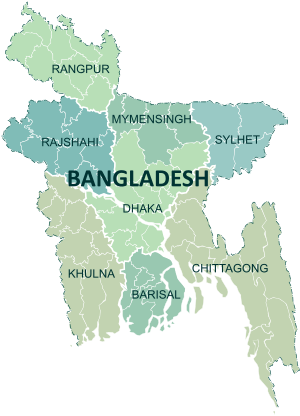
Bangladesh is divided into eight administrative divisions,
[208][209][210] each named after their respective divisional headquarters:
Barisal,
Chittagong,
Dhaka,
Khulna,
Mymensingh,
Rajshahi,
Sylhet and
Rangpur.
Divisions are subdivided into districts (
zila). There are 64 districts in Bangladesh, each further subdivided into
upazila (subdistricts) or
thana. The area within each police station, except for those in metropolitan areas, is divided into several
unions,
with each union consisting of multiple villages. In the metropolitan
areas, police stations are divided into wards, which are further divided
into
mahallas.
There are no elected officials at the divisional or district levels,
and the administration is composed only of government officials. Direct
elections are held for each union (or ward), electing a chairperson and a
number of members. In 1997, a parliamentary act was passed to reserve
three seats (out of 12) in every union for female candidates.
[211]
| Administrative Divisions of Bangladesh |
| Division |
Capital |
Established |
Area (km2)[212] |
Population[212] |
Density[212] |
| Barisal |
Barisal |
1 January 1993
|
13,297
|
8,325,666
|
626
|
| Chittagong |
Chittagong |
1829
|
33,771
|
28,423,019
|
841
|
| Dhaka |
Dhaka |
1829
|
20,593
|
36,054,418
|
1,751
|
| Khulna |
Khulna |
1 October 1960
|
22,272
|
15,687,759
|
704
|
| Mymensingh |
Mymensingh |
14 September 2015
|
10,584
|
11,370,000
|
1,074
|
| Rajshahi |
Rajshahi |
1829
|
18,197
|
18,484,858
|
1,015
|
| Rangpur |
Rangpur |
25 January 2010
|
16,317
|
15,787,758
|
960
|
| Sylhet |
Sylhet |
1 August 1995 |
12,596
|
9,910,219
|
780
|
Economy
Bangladesh is a
developing country, with a
market-based mixed economy and is listed as one of the
Next Eleven emerging markets. The
per capita income of Bangladesh was US$1,190 in 2014, with a GDP of US$209 billion.
[213] In
South Asia, Bangladesh has the third-largest economy after those of India and
Pakistan, and has the second highest
foreign exchange reserves after India. The
Bangladeshi diaspora contributed US$15.31 billion in
remittances in 2015.
[214]
In the early five years of independence, Bangladesh adopted socialist
policies which proved to be a critical blunder by the Awami League.
[215] The subsequent military regime and
BNP and
Jatiya Party governments restored
free markets and promoted the Bangladeshi private sector. In 1991, finance minister
Saifur Rahman launched a range of
liberal reforms. The Bangladeshi private sector has since rapidly expanded, with numerous
conglomerates now driving the economy. Major industries include textiles,
pharmaceuticals, shipbuilding, steel, electronics, energy, construction materials, chemicals, ceramics, food processing, and leather goods.
Export-oriented industrialization has increased in recent years, with the country's exports amounting to US$30 billion in FY2014-15.
[216] The predominant export earnings of Bangladesh come from its
garments sector. The country also has a vibrant
social enterprise sector, including the
Nobel Peace Prize-winning
microfinance institution
Grameen Bank and the world's largest non-governmental development agency
BRAC.
The insufficient power supply is a significant obstacle to growth. According to the
World Bank, poor governance,
corruption and weak public institutions are major challenges for Bangladesh's development.
[217] In April 2010,
Standard & Poor's awarded Bangladesh a BB- long term
credit rating, which is below India and well above Pakistan and Sri Lanka.
[218]
Primary
Jute is one of the main agricultural commodities of Bangladesh
Black Tiger Prawns. Bangladesh is the world's fifth largest fish and seafood producer
Bangladesh is notable for its
fertile land, including the
Ganges delta, the
Sylhet Division and the
Chittagong Hill Tracts.
Agriculture
is the single largest producing sector of the economy since it
comprises about 18.6% (data released on November, 2010) of the country's
GDP and employs around 45% of the total labor force.
[219] The performance of this sector has an overwhelming impact on major macroeconomic objectives like
employment generation,
poverty alleviation, human resources development and
food security. A plurality of Bangladeshis earn their living from
agriculture. The country ranks among the top producers of
rice (4th),
fish (5th),
jute (2nd),
tea (10th) and
tropical fruits (5th).
[220][221]
Bangladesh is the 7th largest
natural gas producer in Asia, ahead of its neighbor
Myanmar. Gas supplies generate 56% of the country's electricity. Major gas fields are located in northeastern (particularly
Sylhet) and southern (including
Barisal and
Chittagong) regions.
Petrobangla is the national energy company. The American multinational
Chevron produces 50% of Bangladesh's
natural gas.
[222] According to geologists, the
Bay of Bengal holds large untapped gas reserves in Bangladesh'
exclusive economic zone.
[223] The country also has substantial reserves of
coal, with several coal mines operating in northwestern Bangladesh.
Jute
exports continue to be significant, however the global jute trade has
reduced considerably since it peaked during World War II. Bangladesh has
one of the oldest
tea industries in the world. It is also major exporter of
fish and
seafood.
Secondary
Shirts produced at a Bangladeshi textile factory. The country is one of the world's largest garments exporters
The
Bangladesh textile industry is the largest manufacturing sector, accounting for US$25 billion in exports in 2014.
[224] Leather goods manufacturing, particularly in footwear, is the second largest export oriented industrial sector. The
pharmaceutical industry in Bangladesh meets 97% of domestic demand and exports to 52 countries.
[225][226] The
shipbuilding industry in Bangladesh has seen rapid growth with exports to
Europe.
[227]
The
steel industry in Bangladesh is concentrated in the port city of
Chittagong. The
ceramics industry in Bangladesh is a prominent player in the international ceramics trade. In 2005, Bangladesh was the world's 20th largest
cement producer. The country's cement industry depends on
limestone imports from
North East India.
Food processing is a major sector of the local economy, with prominent brands like
PRAN that are increasingly gaining an international market. The
electronics industry in Bangladesh is witnessing rapid growth, with the
Walton Group being its dominant player.
[228] Bangladesh also has its own defense industry, including the establishments such as
Bangladesh Ordnance Factories and the
Khulna Shipyard.
Tertiary
The service sector accounts for 51% of GDP. Bangladesh ranks with Pakistan in having the second largest
banking sector in South Asia.
[229] The
Dhaka Stock Exchange and the
Chittagong Stock Exchange are the twin financial markets of the country. The
telecoms industry in Bangladesh is one of the fastest growing markets in the world, with 114 million cellphone subscribers in December 2013.
[230] The main telecom companies are
Grameenphone,
Banglalink,
Robi,
Airtel and
BTTB.
Tourism in Bangladesh is a developing sector, with the beach resort town of
Cox's Bazar being the center of the industry. The Sylhet region, home to Bangladesh's
tea country, also receives a large number of visitors. Bangladesh has
three UNESCO World Heritage Sites, and five tentative listed sites.
Microfinance was pioneered in Bangladesh by
Muhammad Yunus and has been replicated in many countries. There are more than 35 million
microcredit borrowers.
[231]
Transport
Transport is a major sector in the Bangladesh economy. The
aviation industry has seen rapid growth and includes the national flag carrier
Biman and other privately owned airlines. The country has a 2,706 km rail network operated by the
Bangladesh Railway. It has one of the largest inland
waterway networks in the world,
[232] with 8,046 km of navigable waterways. The southeastern
Port of Chittagong is its busiest
seaport, handling over US$60 billion in annual trade.
[233] More than 80% of the country's export-import trade passes through Chittagong.
The second busiest seaport is
Mongla in southwestern Bangladesh.
Energy
Electricity generation in Bangladesh had an installed capacity of 10,289 MW in January 2014.
[234] Commercial energy consumption is mostly natural gas (around 56%), followed by oil, hydropower and coal.
Bangladesh has planned to import
hydropower from
Bhutan and
Nepal.
[235]
Nuclear energy in Bangladesh is being developed with
Russia in the landmark
Ruppur Nuclear Power Plant project.
[236]
In
renewable energy,
Bangladesh has the fifth-largest number of green jobs in the world.
Solar panels are increasingly used to power both urban and off grid
rural areas.
[237]
Water
The share of the population with access to an
improved water source was estimated at 98% in 2004,
[238]
a very high level for a low-income country. This has been achieved to a
large extent through the construction of handpumps with the support of
external donors. However, in 1993 it was discovered that groundwater,
the source of drinking water for 97% of the rural population and a
significant share of the urban population, is in many cases naturally
contaminated with arsenic.
Another challenge is the low level of cost recovery due to low tariffs and poor
economic efficiency,
especially in urban areas where revenues from water sales do not even
cover operating costs. Concerning sanitation, estimated 56% of the
population have had access to adequate sanitation facilities in 2010.
[239] A new approach to improve sanitation coverage in rural areas, the
community-led total sanitation
concept that has been first introduced in Bangladesh, is credited for
having contributed significantly to the increase in sanitation coverage
since 2000.
[240]
Science and technology
SPARRSO, Bangladesh's
space agency, was founded in 1983 with assistance from the
United States.
[241] Bangladesh plans to launch the
Bangabandhu-1 communications satellite in 2018.
[242] The
Bangladesh Atomic Energy Commission operates a
TRIGA research reactor at its atomic energy facility in
Savar.
[243] The
Bangladesh Council of Scientific and Industrial Research was founded in 1973, and traces to its roots to the East Pakistan Regional Laboratories established in Dhaka (1955),
Rajshahi (1965) and
Chittagong (1967).
IT Outsourcing
Bangladesh has a large number of trained IT professionals. But as the
majority of the businesses have not become large enough and on the
other hand due to negligence from the part of business owners to
understand the benefits of using software and technology in businesses
the local demand for these highly skilled professionals has been low. As
a result, the IT industry in Bangladesh has turned its focus on
exporting software and it services. Currently it is in 26th position of
global IT outsourcing destination.
[244]
The primary reason behind this is Bangladeshi IT companies are
providing high quality services at a much lower cost than its
competitors. It is currently estimated that the volume of IT outsourcing
is doubling every year in Bangladesh. Several Bangladeshi IT companies
has been successful in the global enterprise software market.
Bangladeshi Government is envisioning IT sector as the second largest
export sector after Garments in the coming years.
Demographics
| Historical populations in millions |
| Year |
Pop. |
±% p.a. |
| 1971 |
67.8 |
— |
| 1980 |
80.6 |
+1.94% |
| 1990 |
105.3 |
+2.71% |
| 2000 |
129.6 |
+2.10% |
| 2010 |
148.7 |
+1.38% |
| 2012 |
161.1 |
+4.09% |
| Source: OECD/World Bank[245] |
Estimates of the Bangladeshi population vary but most recent data
suggest 162 to 168 million people (2015). However, the 2011 census
estimated 142.3 million,
[246] much less than recent (2007–2010) estimates of Bangladesh's population ranging from 150 to 170 million. Bangladesh is thus the
8th most populous nation in the world. In 1951, the population was only 44 million.
[247]
It is also the most densely populated large country in the world, and
it ranks 11th in population density, when very small countries and
city-states are included.
[248]
Bangladesh's population growth rate was among the highest in the
world in the 1960s and 1970s, when its population grew from 65 to
110 million. With the promotion of
birth control
in the 1980s, the growth rate began to slow. The fertility rate now
stands at 2.55, lower than India (2.58) and Pakistan (3.07) The
population is relatively young, with 34% aged 15 or younger and 5% 65 or
older.
Life expectancy at birth is estimated to be 70 years for both males and females in 2012.
[209] Despite the rapid economic growth, about 26% of the country still lives below the
international poverty line which means living on less than $1.25 per day.
[249] Bengalis constitute 98% of the population.
[250]
Minorities include
indigenous people in the
Chittagong Hill Tracts and other parts of northern Bangladesh. The Hill Tracts are home to 11 ethnic tribal groups, notably the
Chakma,
Marma,
Tanchangya,
Tripuri,
Kuki, Khiang, Khumi,
Murang,
Mru,
Chak,
Lushei and
Bawm. The
Sylhet Division is home to the
Bishnupriya Manipuri,
Khasi and
Jaintia tribes. The
Mymensingh District has a substantial
Garo population. The
northern Bangladesh region is home to aboriginal
Santal,
Munda and
Oraon people. Bangladesh is also home to a significant
Ismaili community.
[251]
The southeastern region has received an influx of
Rohingya refugees from Burma, particularly during Burmese military crackdowns in 1978 and 1991.
[252] During renewed
sectarian unrest in Rakhine State in 2012, Bangladesh closed its borders amid fears of a third major exodus from Burma.
[253] Stranded Pakistanis
or Biharis are a contentious dispute between Bangladesh and Pakistan.
In 2008, the Bangladesh High Court granted full citizenship to all
second generation Stranded Pakistanis born after 1971.
[254] The Hill Tracts region suffered unrest and an
insurgency from 1975 to 1997 due to a movement by indigenous people for autonomy. A
peace accord was signed in 1997; however, the region remains heavily militarized.
[255]
Urban centres
|
Largest cities or towns in Bangladesh
2011 calculation[256]
|
|
Rank |
Name |
Division |
Pop. |
Rank |
Name |
Division |
Pop. |
|

Dhaka
Chittagong |
1 |
Dhaka |
Dhaka |
7,033,076 |
11 |
Rangpur |
Rangpur |
294,265 |

Khulna

Narayanganj |
| 2 |
Chittagong |
Chittagong |
2,592,439 |
12 |
Mymensingh |
Mymensingh |
258,040 |
| 3 |
Khulna |
Khulna |
663,342 |
13 |
Gazipur |
Dhaka |
213,061 |
| 4 |
Narayanganj |
Dhaka |
543,090 |
14 |
Jessore |
Khulna |
201,796 |
| 5 |
Sylhet |
Sylhet |
479,837 |
15 |
Dinajpur |
Rangpur |
186,727 |
| 6 |
Tongi |
Dhaka |
476,350 |
16 |
Nawabganj |
Rajshahi |
180,731 |
| 7 |
Rajshahi |
Rajshahi |
449,756 |
17 |
Brahmanbaria |
Chittagong |
172,017 |
| 8 |
Bogra |
Rajshahi |
350,397 |
18 |
Cox's Bazar |
Chittagong |
167,477 |
| 9 |
Barisal |
Barisal |
328,278 |
19 |
Tangail |
Dhaka |
167,412 |
| 10 |
Comilla |
Chittagong |
326,386 |
20 |
Chandpur |
Chittagong |
159,021 |
Dhaka is the capital and largest city of Bangladesh. The cities with a
city corporation, having mayoral elections, include Dhaka South, Dhaka North,
Chittagong,
Khulna,
Sylhet,
Rajshahi,
Barisal,
Rangpur,
Comilla and
Gazipur. Other major cities, these and other municipalities electing a chairperson, include
Mymensingh,
Gopalganj,
Jessore,
Bogra,
Dinajpur,
Saidpur,
Narayanganj and
Rangamati. Both the municipal heads are elected for a span of five years.
Languages
Bangla (Bengali) being the sole official language,
[257] English is sometimes used secondarily for official purposes, especially in the judiciary.
More than 98% of Bangladeshis speak
Bangla as their native language.
[258][259]
English is also used as a second language among the middle and upper
classes and is also widely used in higher education and the legal
system.
[260]
Historically, laws were written in English and were not translated into
Bangla until 1987. Bangladesh's Constitution and all laws are now in
both English and Bangla.
[261]
Stranded Pakistani Biharis since 1971 living in various camps in Bangladesh speak
Urdu.
[262] Similarly, Rohingya Refugees from
Burma since 1978 living in various camps in Bangladesh speak
Rohingya.
[263] There are also several
indigenous minority languages.
Religion
Islam is the largest religion in Bangladesh, adhered to by about 87% of the population. The country is home to most
Bengali Muslims, the second largest ethnic group in the
Muslim world. The majority of Bangladeshi Muslims are
Sunni, followed by the
Shia and
Ahmadiya. Roughly 4% are
non-denominational Muslims.
[265] Bangladesh has the fourth-largest Muslim population in the world and is the third-largest
Muslim-majority country after Indonesia and Pakistan.
[266]
Hinduism is followed by about 12% of the population, with most being
Bengali Hindus.
Bangladeshi Hindus are the country's second biggest religious group and
the third largest Hindu community in the world after those of India and
Nepal.
Hindus in Bangladesh are almost evenly distributed in all regions, with
significant concentrations in northern, northeastern and southwestern
parts of the country.
Buddhism is the third largest religion, at 0.6%. Bangladeshi Buddhists are largely concentrated among
ethnic groups in the
Chittagong Hill Tracts, particularly the
Chakma,
Marma and
Tanchangya peoples; while coastal Chittagong is home to the large number of
Bengali Buddhists.
Christianity is the fourth largest religion at 0.3%.
[267]
The remaining 0.1% population follow various folk religions and animistic faiths.
Many people in Bangladesh practice
Sufism, which has a long heritage in the region.
[268] The largest gathering of Muslims in the country is the
Bishwa Ijtema, held annually by the
Tablighi Jamaat. The Ijtema is the second largest Muslim congregation in the world after the
Hajj.
The
Constitution of Bangladesh declares Islam as the
state religion, but bans religion-based politics. It proclaims equal recognition of
Hindus,
Buddhists,
Christians and people of all faiths.
[269] Earlier in 1972, Bangladesh became the first constitutionally secular country in South Asia.
[270] The
U. S. State Department describes Bangladesh as a
secular pluralistic democracy.
[271]
Education
Bangladesh has a low
literacy rate, estimated at 66.5% for males and 63.1% for females in 2014.
[209]
The educational system in Bangladesh is three-tiered and highly
subsidized. The government operates many schools in the primary,
secondary, and higher secondary levels. It subsidises parts of the
funding for many private schools. In the tertiary education sector, the
government funds more than 15 state universities through the
University Grants Commission.
The education system is divided into five levels: Primary (from
grades 1 to 5), Junior Secondary (from grades 6 to 8), Secondary (from
grades 9 to 10), Higher Secondary (from grades 11 to 12) and tertiary.
[272] The five years of lower secondary education concluded with a
Secondary School Certificate
(SSC) examination, but since 2009 it concludes with a Primary Education
Closing (PEC) examination. Earlier, students who pass this examination
proceed to four years secondary or matriculation training, which
culminate in a Secondary School Certificate (SSC) Examination.
[272]
Bangladeshi schoolchildren performing on a stage
Primary Education Closing (PEC) passed examinees proceed to three years Junior Secondary, which culminate in a
Junior School Certificate
(JSC) Examination. Students who pass this examination proceed to two
years secondary or matriculation training, which culminate in a
Secondary School Certificate (SSC) examination. Students who pass this
examination proceed to two years of Higher Secondary or intermediate
training, which culminate in a
Higher Secondary School Certificate (HSC) examination.
[272]
Education is mainly offered in Bengali, but English is commonly
taught and used. A large number of Muslim families send their children
to attend part-time courses or even to pursue full-time religious
education, which is imparted in Bengali and
Arabic in madrasahs.
[272]
Bangladesh conforms fully to the
Education For All (EFA) objectives, the
Millennium Development Goals (MDG) and international declarations. Article 17 of the
Bangladesh Constitution provides that all children between the ages of six and ten years receive a basic education free of charge.
Universities in Bangladesh
are mainly categorized into three types: public (government owned and
subsidized), private (private sector owned universities) and
international (operated and funded by international organizations).
Bangladesh has 34 public, 64 private and two international
universities.
Bangladesh National University has the largest enrollment among them and
University of Dhaka (established 1921) is the oldest.
Islamic University of Technology, commonly known as IUT, is a subsidiary organ of the Organisation of the Islamic Cooperation (
OIC), representing 57 member countries from Asia, Africa, Europe and South America.
Asian University for Women
in Chittagong is the preeminent liberal arts university for women in
South Asia, representing 14 countries from Asia. The faculty members are
from many well-known academic institutions of North America, Europe,
Asia, Australia, and the Middle East.
[273] BUET,
CUET,
KUET,
RUET are the four public engineering universities in the country.
BUTex and
DUET
are two specialized engineering universities, where BUTex specializes
in Textile Engineering and DUET offers higher education to
Diploma Engineers. There are some science and technology universities including
SUST,
MIST,
PUST, etc.
Bangladeshi universities are accredited by and affiliated with the
University Grants Commission
(UGC), created according to the Presidential Order (P.O. No 10 of 1973)
of the government of the People's Republic of Bangladesh.
[274]
Medical education is provided by 29 government and some other private
medical colleges. All medical colleges are affiliated with
Ministry of Health and Family Welfare.
Recently the literacy rate of Bangladesh has improved as it stands at 71% as of 2015
due to the modernization of schools and education funds. At present,
16,087 schools and 2,363 colleges were getting Monthly Pay Order (MPO)
facilities. 27,558 madrasas, and technical and vocational institutions
were enlisted for the facilities. 6036 educational institutions were
outside the MPO coverage and that the ruling party enlisted 1,624
private schools for MPO in 2010.
[275][276]
Health
Health and education levels remain relatively low, although they have improved recently as poverty (26% at 2012
[277])
levels have decreased. In the rural areas, village doctors with little
or no formal training constitute 62% of the healthcare providers
practicing modern medicine and the formally trained providers are
occupying a mere 4% of the total health workforce. A survey conducted by
Future Health Systems revealed significant deficiencies in treatment
practices of village doctors, with a wide prevalence of harmful and
inappropriate drug prescriptions.
[278]
There are market incentives for accessing health care through informal
providers and it is important to understand these markets in order to
facilitate collaboration across actors and institutions in order to
provide incentives for better performance.
[279]
A 2007 study of 1000 households in rural Bangladesh found that direct
costs (payment to formal and informal health care providers) and
indirect costs (loss of earnings associated with workdays lost because
of illness) associated with illness were important deterrents to
accessing health care from qualified healthcare providers.
[278]
A community survey with 6183 individuals in rural Bangladesh found a
clear gender difference in treatment-seeking behaviour, with women less
likely to seek treatment compared to men.
[280]
The use of skilled birth attendants, however, has risen between 2005
and 2007 by women in all wealth quintiles except the highest quintile.
[281]
A pilot community empowerment tool, called a health watch, was
successfully developed and implemented in south-eastern Bangladesh in
order to improve uptake and monitoring of public health services.
[282]
The poor health conditions in Bangladesh is attributed by the lack of
healthcare and services provision by the government. The total
expenditure on healthcare as a percentage of their GDP was only 3.35% in
2009, according to a World Bank report published in 2010.
[283] The number of hospital beds per 10,000 population is 4.
[284] The General government expenditure on healthcare as a percentage of total government expenditure was only 7.9% as of 2009
and the citizens pay most of their health care bills as the
out-of-pocket expenditure as a percentage of private expenditure on
health is 96.5%.
[283]
Malnutrition has been a persistent problem for the poverty-stricken country. The
World Bank estimates that Bangladesh is ranked 1st in the world of the number of children suffering from
malnutrition.
[285][286] In Bangladesh, 26% of the population are undernourished
[287] and 46% of the children suffers from moderate to severe underweight problem.
[288]
43% of children under 5 years old are stunted. One in five preschool
age children are vitamin A deficient and one in two are anemic.
[289]
Child malnutrition in Bangladesh is amongst the highest in the world.
Two-thirds of the children, under the age of five, are under-nourished
and about 60% of them, who are under six, are stunted.
[290] More than 45 percent of rural families and 76 percent of urban families were below the acceptable caloric intake level.
[291]
Culture
Literature
The oldest evidence of writing in Bangladesh is the Mahasthan
Brahmi Inscription, which dates back to the 3rd century BCE.
[292] During the
Gupta Empire,
Sanskrit literature thrived in the region.
Bengali developed from
Sanskrit and
Magadhi Prakrit in the 11th century.
Bengali literature is a millennium old tradition. The
Charyapada are the earliest examples of Bengali poetry.
Sufi spiritualism inspired many
Bengali Muslim writers. During the
Bengal Sultanate, medieval Bengali writers were influenced by
Arabic and
Persian works.
Syed Alaol was a noted secular poet and translator. The
Chandidas are an example of
Bangladeshi folk literature which developed during the Middle Ages. The
Bengal Renaissance shaped the emergence of modern Bengali literature, including novels, short stories and
science fiction.
Rabindranath Tagore was the first non-European laureate of the
Nobel Prize in Literature and is described as the Bengali Shakespeare.
[293] Kazi Nazrul Islam was a revolutionary poet who espoused spiritual rebellion against colonialism and fascism.
Begum Rokeya was a pioneer of
Bengali writing in English, with her early of work of
feminist science fiction. Other renaissance icons included
Michael Madhusudan Dutt and
Sarat Chandra Chattopadhyay.
The eminent writer
Syed Mujtaba Ali is noted for his cosmopolitan Bengali worldview.
[294] Humayun Ahmed was a popular writer of modern Bangladeshi
magical realism and
science fiction.
Shamsur Rahman was the poet laureate of Bangladesh for many years.
Jasimuddin was a renowned pastoral poet.
Farrukh Ahmed,
Sufia Kamal,
Kaiser Haq and
Nirmalendu Goon are important figures of modern Bangladeshi poetry. Notable writers of Bangladeshi novels include
Mir Mosharraf Hossain,
Akhteruzzaman Elias,
Syed Waliullah,
Shahidullah Kaiser,
Shawkat Osman,
Selina Hossain,
Taslima Nasreen,
Haripada Datta,
Razia Khan,
Anisul Hoque,
Al Mahmud,
Bipradash Barua,
Tahmima Anam,
Neamat Imam,
Monica Ali and
Zia Haider Rahman. Many Bangladeshi writers, such as
Muhammad Zafar Iqbal,
K. Anis Ahmed and
Farah Ghuznavi, are acclaimed for their
short stories.
The annual
Ekushey Book Fair and
Dhaka Literature Festival organized by the
Bangla Academy are among the largest literary festivals in South Asia.
Women in Bangladesh
Although, as of 2015, several women occupy major political office in
Bangladesh, the women of the country continue to suffer under a
patriarchal social regime where violence is common.
[295] Female wage rates in the 1980s were low, typically ranging between 20 and 30 percent of male wage rates.
[citation needed]
Whereas in India and Pakistan women participate less in the workforce
as their education increases, in Bangladesh there is an opposite trend.
[295]
Bengal has a long history of
feminist activism dating back to the 19th century.
Roquia Sakhawat Hussain and
Faizunnessa Chowdhurani played an important role in emancipating Bengali Muslim women from the
purdah
in undivided Bengal and promoting girls' education. Several women were
elected to the Bengal Legislative Assembly in the British Raj. The first
women's magazine
Begum was published in 1948. Women played an important role in Bengali
civil society in
East Pakistan.
[citation needed]
Female workforce participation in Bangladesh is among the highest in the
Muslim world, at 59%.
[296] Women dominate
blue collar jobs in the
Bangladeshi garment industry. Agriculture, social services, healthcare and education are also major occupations for Bangladeshi women; while employment in
white collar jobs has steadily increased.
Architecture
The architectural traditions of Bangladesh have a 2,500-year-old heritage.
[297] Terracotta architecture is a distinct feature of Bengal. Pre-Islamic Bengali architecture reached its pinnacle during the
Pala Empire, when the Pala School of Sculptural Art established grand structures such as the
Somapura Mahavihara.
Islamic architecture began developing under the
Bengal Sultanate, when local terracotta styles influenced medieval
mosque construction. The
Adina Mosque of undivided Bengal was the largest mosque built in the Indian subcontinent.
The
Sixty Dome Mosque was the largest medieval mosque built in Bangladesh, and is a fine example of Turkic-Bengali architecture. The
Mughal style replaced indigenous architecture when Bengal became a province of the
Mughal Empire and influenced the development of urban housing. The
Kantajew Temple and
Dhakeshwari Temple are excellent examples of late medieval
Hindu temple architecture.
Indo-Saracenic Revival architecture, based on Indo-Islamic styles, flourished during the
British period. The
zamindar gentry in Bangladesh built numerous Indo-Saracenic palaces and country mansions, such as the
Ahsan Manzil,
Tajhat Palace,
Dighapatia Palace,
Puthia Rajbari and
Natore Rajbari.
Bengali
vernacular architecture is noted for pioneering the
bungalow. Bangladeshi villages consist of
thatched roofed houses made of natural materials like
mud,
straw,
wood and
bamboo. In modern times, village bungalows are increasingly made of
tin.
Muzharul Islam
was the pioneer of Bangladeshi modern architecture. His varied works
set the course of modern architectural practice in the country. Islam
brought leading global architects, including
Louis Kahn,
Richard Neutra,
Stanley Tigerman,
Paul Rudolph,
Robert Boughey and
Konstantinos Doxiadis, to work in erstwhile
East Pakistan. Louis Kahn was chosen to design the National Parliament Complex in
Sher-e-Bangla Nagar. Kahn's monumental designs, combining regional red brick aesthetics, his own concrete and marble
brutalism
and the use of lakes to represent Bengali geography, are regarded as
one of the masterpieces of the 20th century. In more recent times, award
winning architects like
Rafiq Azam have set the course of contemporary architecture by adopting influences from Islam and Kahns' works.
- Traditional architecture of Bangladesh
-
-
-
Islamic terracotta on the Atia Mosque
-
-
-
Performance arts
The
Baul tradition is a UNESCO Masterpiece of the Cultural Heritage of Humanity.
Theatre in Bangladesh includes various forms, with a history dating back to the 4th century AD.
[298]
It includes narrative forms, song and dance forms, supra-personae
forms, performances with scroll paintings, puppet theatre and
processional forms.
[298] The
Jatra
is the most popular form of Bengali folk theatre. The dance traditions
of Bangladesh include indigenous tribal and Bengali dance forms, as well
as
classical Indian dances, including the
Kathak,
Odissi and the
Manipuri dances.
The
music of Bangladesh features the
Baul mystical tradition, listed by
UNESCO as a
Masterpiece of Intangible Cultural Heritage.
[299] Numerous lyric based musical traditions exist including
Gombhira,
Bhatiali and
Bhawaiya, varying from one region to the next. Folk music is accompanied by the
ektara, an instrument with only one string. Other instruments include the
dotara,
dhol,
flute, and
tabla. Bengali classical music includes
Tagore songs and
Nazrul geeti. Bangladesh has a rich tradition of
Indian classical music, which uses instruments like the
sitar,
tabla,
sarod and
santoor.
[300]
Bangladesh has a rich heritage of ancient Indian and Islamic art, including in
painting,
sculpture and
architecture.
Terracotta works are a distinctive feature of Bengali art. Bengal also influenced the art of
China,
Japan, South East Asia and
Tibet. The Pala-Sena School is regarded as the high point of ancient Bengali art. Islamic medieval art was highly influenced by
Persian art, particularly in architecture,
gardening and
miniature painting. The
Mughal Emperors patronized the weaving of artistic Bengali
silk and
muslin textiles, including the famed
Jamdani muslin. The
Nawabs of Bengal were noted for patronizing
ivory craftsmanship.
Modern
Bangladeshi art began with the works of
Zainul Abedin, a renowned painter. Other notable painters include
SM Sultan,
Mohammad Kibria,
Shahabuddin Ahmed,
Quamrul Hassan,
Qayyum Chowdhury and
Kanak Chanpa Chakma. Notably early modern sculptors included
Novera Ahmed and
Nitun Kundu. The country has a thriving
contemporary art scene which has received international acclaim. The
Dhaka Art Summit is a biannual event showcasing Bangladeshi works to an international audience.
Bangladeshi martial arts evolved in villages where
zamindars employed large private armies to protect their landholdings. The
Lathi khela and
Boli Khela are two major forms of Bengali martial arts.
Textiles
The
Nakshi Kantha is a centuries-old
embroidery tradition for
quilts,
said to be indigenous to eastern Bengal (Bangladesh). The sari is the
national dress for Bangladeshi woman. Mughal Dhaka was renowned for
producing the finest
muslin saris, including the famed
Dhakai and
Jamdani, the weaving of which is listed by
UNESCO as one of the masterpieces of humanity's intangible cultural heritage.
[301] Bangladesh also produces the
Rajshahi silk. The
shalwar kameez is also widely worn by Bangladeshi women. In urban areas some women can be also seen in western clothing. The
kurta and
sherwani are the national dresses of Bangladeshi men. The
lungi and
dhoti is worn by Bengali men in informal settings. The handloom industry supplies of 60-65% of clothing demand.
[302] Aside from ethnic wear, domestically
tailored suits and
neckties are usually worn by men in the country, and it is customary in offices, schools and social events.
The Bengali ethnic
fashion industry has flourished well in the changing environment of the fashion world. The retailer
Aarong is one of the most successful ethnic wear brands in South Asia. The development of the
Bangladesh textile industry,
which supplies leading international brands, has promoted the
production and retail of modern Western attire locally, with the country
now having a number of expanding local brands like Westecs and Yellow.
Bangladesh is the world's second largest garments exporter.
Among Bangladesh's fashion designers,
Bibi Russell has achieved international acclaim for her "Fashion for Development" shows.
[303]
Cuisine
White rice is the staple of Bangladeshi cuisine, along with many
vegetables and
lentils. Rice preparations also include Bengali
biryanis,
pulaos, and
khichuris.
Mustard sauce,
ghee,
sunflower oil and fruit
chutneys are widely used in Bangladeshi cooking.
Fish is the main source of protein in Bengali cuisine. The
Hilsa is the national fish and immensely popular across Bangladesh. Other fishes eaten include
rohu,
butterfish, catfish,
tilapia and
barramundi.
Fish eggs are a gourmet delicacy.
Seafood holds an important place in Bengali cuisine, especially
lobsters,
shrimps and
dried fish.
Meat consumption includes
chicken,
beef,
mutton,
venison,
duck and
squab. In Chittagong,
Mezban feasts are a popular tradition featuring the serving of hot beef
curry. In Sylhet, the
shatkora
lemons are used to marinate dishes. In the tribal Hill Tracts, bamboo
shoot cooking is prevalent. Bangladesh has a vast spread of desserts,
including distinctive
sweets like
Rôshogolla,
Rôshomalai,
Chomchom,
Mishti Doi and
Kalojaam.
Pithas are traditional boiled desserts made with rice or fruits.
Halwa is served during religious festivities.
Naan,
paratha,
luchi and
bakarkhani are the main local breads.
Black tea is offered to guests as a gesture of welcome.
Kebabs are widely popular across Bangladesh, particularly
seekh kebabs,
chicken tikka and
shashliks.
Bangladesh shares its culinary heritage with the neighboring Indian state of
West Bengal.
The two regions have several differences, however. In Muslim-majority
Bangladesh, meat consumption is greater; whereas in Hindu-majority West
Bengal, vegetarianism is more prevalent. The Bangladeshi diaspora
dominates the South Asian restaurant industry in many Western countries,
particularly in the
United Kingdom.
Festivals
Pohela Boishakh, the Bengali new year, is the major festival of
Bengali culture
and sees widespread festivities. Of the major holidays celebrated in
Bangladesh, only Pohela Boishakh comes without any preexisting
expectations (specific religious identity, culture of gift-giving,
etc.). Unlike holidays like Eid al-Fitr, where dressing up in lavish
clothes has become a norm, or Christmas where exchanging gifts has
become an integral part of the holiday, Pohela Boishakh is really about
celebrating the simpler, rural roots of the Bengal. As a result, more
people can participate in the festivities together without the burden of
having to reveal one's class, religion, or financial capacity. Other
cultural festivals include
Nabonno, and Poush Parbon both of which are Bengali harvest festivals.
The Muslim festivals of
Eid al-Fitr,
Eid al-Adha,
Milad un Nabi,
Muharram,
Chand Raat,
Shab-e-Barat; the Hindu festivals of
Durga Puja,
Janmashtami and
Rath Yatra; the Buddhist festival of
Buddha Purnima, which marks the birth of
Gautama Buddha, and Christian festival of
Christmas are
national holidays in Bangladesh and see the most widespread celebrations in the country.
Alongside there are national days like the remembrance of 21 February 1952
Language Movement Day (
International Mother Language Day),
Independence Day and
Victory Day. On Language Movement Day, people congregate at the
Shaheed Minar in Dhaka to remember the national heroes of the
Bengali Language Movement, and at the
Jatiyo Smriti Soudho on Independence Day and Victory Day to remember the national heroes of the
Bangladesh Liberation War.
These occasions are observed with public ceremonies, parades, rallies
by citizens, political speeches, fairs, concerts, and various other
public and private events celebrating the history and traditions of
Bangladesh. TV and radio stations broadcast special programs and
patriotic songs. And many schools and colleges organise fairs,
festivals, and concerts in which citizens from all levels of society can
participate.
Sports
Cricket is one of the most popular sports in Bangladesh, followed by
football. The
national cricket team participated in their first
Cricket World Cup in 1999, and the following year was granted elite
Test cricket status. But they have struggled to date, recording only ten Test match victories: eight against
Zimbabwe with five in 2005 and three in 2014, the other two came in a 2-0 series victory over the
West Indies in 2009.
[304]
The team has been more successful in
One Day International cricket.
In July 2010, they celebrated their first ever win over England in any
form of match. Later in 2010, they beat New Zealand for the first time.
In late 2012, they won a five-match home ODI series 3-2 against a
full-strength West Indies National team. In 2011, Bangladesh
successfully co-hosted the
ICC Cricket World Cup 2011 with India and
Sri Lanka. In 2012, the country hosted the
Asia Cup.
The team beat India and Sri Lanka but failed to keep the reputation in
the final game against Pakistan. However, it was the first time
Bangladesh had advanced to the final of any major cricket tournament.
They participated at the
2010 Asian Games
in Guangzhou, defeating Afghanistan to claim their Gold Medal in the
first ever cricket tournament held in the Asian Games. Bangladeshi
cricketer
Sakib Al Hasan is no.1 on the
ICC's all-rounder rankings in all three formats of the cricket.
[305]
Kabaddi is a very popular game in Bangladesh, considered the national game.
[306] Other popular sports include
field hockey,
tennis,
badminton,
handball,
basketball,
volleyball,
chess,
shooting,
angling. The
National Sports Council regulates 42 different sporting federations.
[307]
Bangladesh has 5 grandmasters in
chess. Among them,
Niaz Murshed was the first grandmaster in
South Asia. In another achievement,
Margarita Mamun, a Russian
rhythmic gymnast of Bangladeshi origin,became world champion in 2013 and 2014.
Media and cinema
The Bangladeshi press is diverse, outspoken and privately owned. Over 200
newspapers are published in the country.
Bangladesh Betar is the state-run
radio service.
[308] The
British Broadcasting Corporation operates the popular
BBC Bangla news and current affairs service. Bengali broadcasts from
Voice of America are also very popular.
Bangladesh Television (BTV) is the state-owned television network. There more than 20 privately owned television networks, including several
news channels.
Freedom of the media remains a major concern, due to government attempts at censorship and harassment of journalists.
The
cinema of Bangladesh
dates back to 1898, when films began screening at the Crown Theatre in
Dacca. The first bioscope in the subcontinent was established in Dacca
that year. The
Dhaka Nawab Family patronized the production of several
silent films
in the 1920s and 30s. In 1931, the East Bengal Cinematograph Society
released the first full-length feature film in Bangladesh, titled the
Last Kiss. The first feature film in
East Pakistan,
Mukh O Mukhosh,
was released in 1956. During the 1960s, 25-30 films were produced
annually in Dacca. By the 2000s, Bangladesh produced 80-100 films a
year. While the Bangladeshi film industry has achieved limited
commercial success; the country has produced notable independent
filmmakers.
Zahir Raihan was a prominent documentary-maker who was assassinated in 1971. The late
Tareque Masud
is regarded as one of Bangladesh's outstanding directors due to his
numerous productions on historical and social issues. Masud was honored
by
FIPRESCI at the
Cannes Film Festival in 2002 for his film
The Clay Bird.
Tanvir Mokammel,
Mostofa Sarwar Farooki,
Humayun Ahmed,
Alamgir Kabir and
Chashi Nazrul Islam are other prominent directors of Bangladesh cinema.
Rickshaws
Cycle rickshaws are the most popular form of public transport in Bangladesh. There are an estimated one million cycle rickshaws in Bangladesh.
[309] Dhaka, the nation's biggest city, is nicknamed the
Rickshaw Capital of the World.
[309]
Rickshaws also ply the streets of other major cities, as well as the
countryside. Bangladeshi rickshaws are decorated with colorful posters
and boards, often depicting movie stars, national monuments or religious
icons.
Rickshaw art is considered a form of
neo-romanticism. This unique trend started in
Rajshahi and
Dhaka
in the 1950s. Each region of Bangladesh has a distinct style of
rickshaw art. For example, rickshaw art in Chittagong and Comilla are
dominated by floral scenery and Arabic texts. Auto-rickshaws are widely
seen in urban centers. Cycle-driven carts are found in many parts of the
country. Bangladeshi rickshaw art has received international fame, and
has been called "people's art".
Rickshaw driving provides employment for many poor Bangladeshis coming from rural areas.
[310]
Museums and libraries
The
Varendra Research Museum
is the oldest museum in Bangladesh. It houses important collections
from both the pre-Islamic and Islamic periods, including the sculptures
of the Pala-Sena School of Art and the Indus Valley Civilization; as
well as Sanskrit, Arabic and Persian manuscripts and inscriptions. The
Ahsan Manzil,
the former residence of the Nawab of Dhaka, is a national museum
housing collections from the British Raj. It was the site of the
founding conference of the All India Muslim League and hosted many
British Viceroys in Dhaka.
The
Tajhat Palace Museum preserves artifacts of the rich cultural heritage of
North Bengal, including Hindu-Buddhist sculptures and Islamic manuscripts. The
Mymensingh Museum houses the personal antique collections of Bengali aristocrats in central Bengal. The
Ethnological Museum of Chittagong showcases the lifestyle of various tribes in Bangladesh. The
Bangladesh National Museum is located in
Ramna, Dhaka and has a rich collection of antiquities. The
Liberation War Museum documents the Bangladeshi struggle for independence and the 1971 genocide.
In ancient times, manuscripts were written on palm leaves, tree
barks, parchment vellum and terracotta plates and preserved at
monasteries known as
viharas. The
Hussain Shahi dynasty established royal libraries during the
Bengal Sultanate. Libraries were established in each district of Bengal by the
zamindar gentry during the
Bengal Renaissance
in the 19th-century. The trend of establishing libraries continued
until the beginning of World War II. In 1854, four major public
libraries were opened, including the Bogra Woodburn Library, the Rangpur
Public Library, the Jessore Institute Public Library and the Barisal
Public Library.
The
Northbrook Hall Public Library was established in Dacca in 1882 in honour of
Lord Northbrook,
the Governor General. Other libraries established in the British period
included the Victoria Public Library, Natore (1901), the Sirajganj
Public Library (1882), the Rajshahi Public Library (1884), the Comilla
Birchandra Library (1885), the Shah Makhdum Institute Public Library,
Rajshahi (1891), the Noakhali Town Hall Public Library (1896), the Prize
Memorial Library, Sylhet (1897), the Chittagong Municipality Public
Library (1904) and the Varendra Research Library (1910). The Great
Bengal Library Association was formed in 1925.
[312] The
Central Public Library of Dhaka was established in 1959. The
National Library of Bangladesh was established in 1972. The
World Literature Center, founded by
Ramon Magsaysay Award winner
Abdullah Abu Sayeed, is noted for operating numerous
mobile libraries across Bangladesh and was awarded the
UNESCO Jon Amos Comenius Medal.
See also Globalbd24.blogspot.com